
The government was also faced with problems on its balance of payments. It took steps to conserve declining foreign exchange reserves, and began to regulate the production, supply and distribution of gold. It banned forward trading in the yellow metal in November 1962, and introduced gold bonds as well, reveals the RBI's annual report for the year ending June 1963.

While freight traffic has gone up, the Google location data shows more people are stepping out of their homes.

The ruling mean FPIs cannot seek treaty protection against the new withholding tax that companies are required to deduct at source. The apex court order pertains to when the cricketing bodies of Pakistan, India, and Sri Lanka formed a joint committee to conduct the 1996 Cricket World Cup.

The RBI is of the view that it cannot carry out satisfactory due diligence for granting registration because the funding is from a jurisdiction that has been identified by FATF as having weak measures to combat money laundering and terrorist financing.

The volume of shares traded in the stock market had fallen 28 per cent in April. Turnover, or the value of securities changing hands, fell 12.6 per cent. This trend of falling volumes seems to have stabilised in May.

With projections suggesting the number of cases in the city will touch 75,000 by the end of May, civic authorities are working overtime to add to the number of beds.

Radhakishan Damani is the only billionaire to see his wealth grow by around 20% during the lockdown.

FinMin had, recently, notified changes in FDI rules that made prior approval of the government mandatory for foreign investments from countries that share a land border with India. Hong Kong was ranked 14th on the list of countries with FDI flows to India, contributing $4.2 billion between April 2000 and December 2019, the data from DPIIT shows. India received FDI worth $2.34 billion from China in the same period.

Taking credit risks in shorter-tenure funds can help jack up returns considerably, boosting sales.

The regulator last week reached out to custodians for beneficial ownership information of investors coming from China, Hong Kong, and 11 other countries.

The spread of COVID-19 and the accompanying mayhem caused the S&P BSE Sensex to drop over 38.5 per cent from its all-time high of 42,273.9 to a low of 25,981.2 on March 23. Those in the astrology and even numerology segments received more calls than before during the time.

Being part of category-I implies lower compliance burden, simplified know-your-customer norms and documentation requirements, and fewer investment restrictions.

According to experts, the Nifty has continued to form lower top-lower bottom formations, a trend seen in the last five weeks, and witnessed sharp selling towards 9,700 zones.

The bank was worth over Rs 80,000 crore as recently as September 2017. The lender had grown at breakneck speed, helped perhaps by Rana Kapoor's reputation as a banker, willing to aggressively write checks.

Mumbai saw an average 46 per cent decline in congestion during the morning rush hour on Tuesday. New Delhi's data also showed an average 34 per cent decline in congestion during morning.

Experts said the 20 per cent drop in the market poses a challenge for companies that have set the ball rolling on their IPO plans as valuations will now have to realign. This could entail more dilution or lowering of the issue size.

VIX is meant to indicate investors' perception of the annual market volatility over the next 30 calendar days. The higher the value, the higher is the expected volatility and vice versa. VIX touched its historical peak of 85.13 on November 17, 2008, in the aftermath of the collapse of Lehman Brothers. In the past five years, it has stayed below 30.

Dividend distribution tax in FY20 would only be applicable after deducting Rs 70 received from the foreign subsidiary, meaning 20.56 per cent DDT would be paid only on Rs 30.

An analysis of S&P BSE 500 companies suggests that promoters of Indian private-sector companies in particular could end up paying at least 20 per cent more as additional tax on the same dividend income.
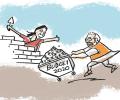
The Budget has relaxed a few safe harbour rules that aim to make it easier for fund managers overseeing offshore India-focused funds to relocate to the country.
 © 2026 Rediff.com - Advertise with us - Disclaimer - Privacy Policy - Sitemap - Feedback - About us - Terms of use - Grievances